
To hire a virtual personal assistant (VPA) effectively, you must first conduct a structured task audit to identify high-frequency, low-complexity workloads suitable for remote delegation, then evaluate candidates using role-specific competency benchmarks aligned to your operational needs. A VPA is a remote professional who manages both administrative workflows and personal logistics, functioning as an on-demand managed service layer between your time and your task load.
Unlike a generalist freelancer, A virtual personal assistant delivers continuity, contextual awareness, and proactive support across inbox management, calendar orchestration, travel coordination, research, and personal errands – all without the fixed overhead of an in-house hire.
If you have never gone through this process before, the options can feel overwhelming. Freelancers, managed agencies, hourly retainers, dedicated plans – each model carries different trade-offs in cost, quality, and control. This guide walks you through every stage of the decision, so you can move forward with clarity and confidence.
If you are ready to skip the research phase entirely, VPERO’s virtual personal assistant services match you with pre-vetted, dedicated VPA professionals built for ongoing, high-trust delegation.
What is a Virtual Personal Assistant (and Why It Matters in 2026)?
A virtual personal assistant is a remote professional who provides a blend of administrative support and personal task management. Unlike a standard virtual assistant focused on one narrow function – such as customer service or data entry – a VPA handles the full spectrum of tasks that occupy a busy professional’s day.
According to research cited by McKinsey, knowledge workers spend less than 30% of their day on high-value, skilled work. The remaining time disappears into coordination, email, scheduling, and administrative noise. A virtual personal assistant directly reclaims that time.
The Core Distinction: Virtual PA vs. General VA
Many first-time buyers confuse these two roles. Here is a quick breakdown:
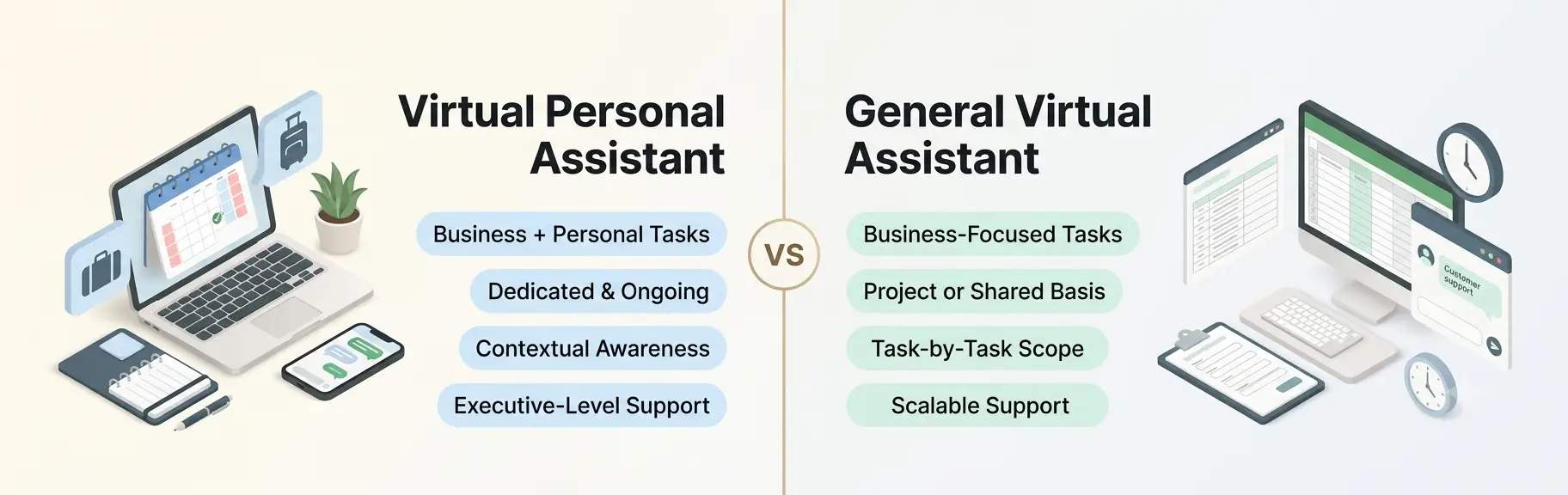
| Feature | Virtual Personal Assistant | General Virtual Assistant |
|---|---|---|
| Scope | Business + personal task management | Primarily business-focused |
| Context awareness | High – remembers preferences and patterns | Medium – task-by-task basis |
| Relationship type | Ongoing, dedicated partnership | Often project-based or shared |
| Typical tasks | Inbox, calendar, travel, errands, research | Data entry, customer support, scheduling |
| Best suited for | Executives, founders, busy professionals | Teams needing scalable task support |
The distinction matters because it shapes your hiring brief, your screening process, and your onboarding expectations.
Step 1: Conduct a Task Audit Before You Hire
The single most common reason first-time buyers struggle after hiring is that they never defined the role properly. Before you write a job description or contact any provider, spend time mapping your workload.
How to Run a Simple Task Audit
- Track your time for five business days. Log every task you complete, including time spent on emails, calls, scheduling, and personal errands.
- Categorize each task into three columns: High-value (only you can do this), Medium-value (you could teach this), and Low-value (repetitive, rules-based).
- Flag every low- and medium-value task as potential delegation candidates.
- Group the flagged tasks by skill set: Do they require admin skills, research skills, communication skills, or personal logistics management?
This process gives you a concrete delegation brief – not a vague job description, but an actual list of deliverables your VPA will own from day one.
Tasks Commonly Delegated to a Virtual Personal Assistant
A capable VPA can take over a surprisingly wide range of responsibilities, including:
- Inbox management: Triaging email, flagging priorities, drafting replies, unsubscribing from noise
- Calendar orchestration: Scheduling meetings, blocking focus time, coordinating across time zones
- Travel planning: Booking flights, hotels, ground transport, and building detailed itineraries
- Research tasks: Competitor analysis, vendor comparisons, background research, market briefings
- Personal errands: Online purchases, gift research, reservations, appointment bookings
- Document preparation: Reports, presentations, meeting agendas, and follow-up summaries
- CRM and contact management: Keeping records updated, logging interactions, preparing outreach lists
- Social media scheduling: Queuing content, monitoring mentions, and tracking basic engagement metrics
If a task can be explained in a written brief or short video, a well-matched VPA can handle it remotely.
Step 2: Choose the Right Hiring Model
Once you know what you need, you face the core structural decision: which hiring model fits your situation? Each path has distinct trade-offs.
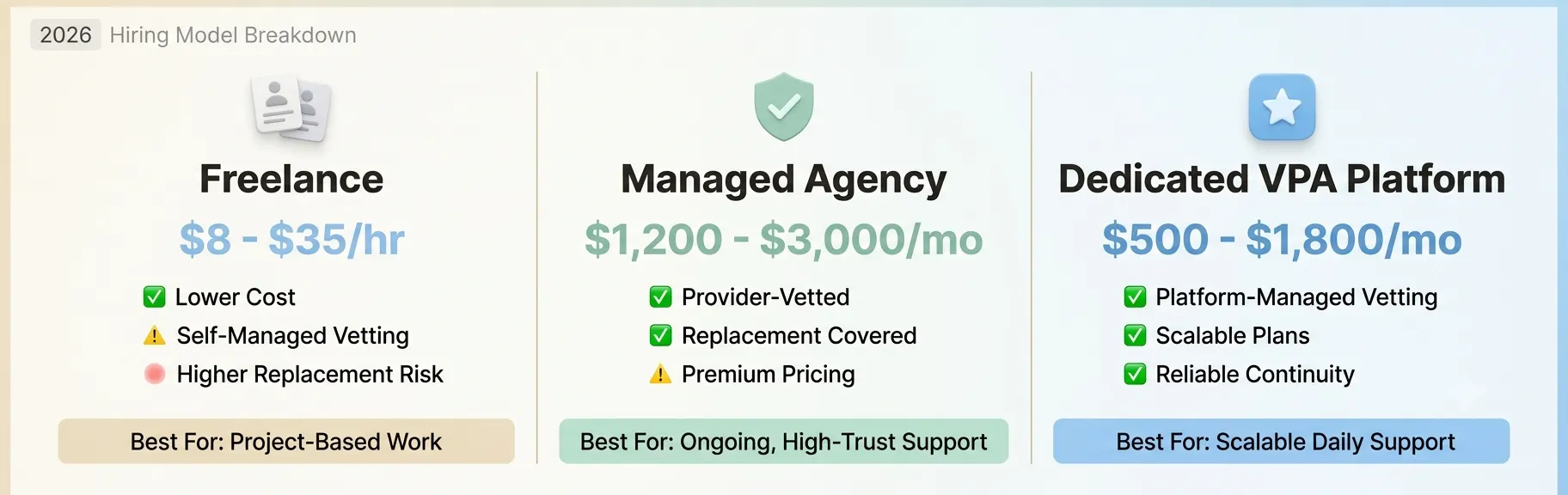
Hiring Model Comparison Table
| Model | Average Cost (2026) | Vetting | Replacement Risk | Best For |
|---|---|---|---|---|
| Freelance marketplace (e.g., Upwork) | $8 – $35/hour | Self-managed | High – you re-hire | Budget-conscious, project-based |
| Managed VA agency | $1,200 – $3,000/month | Provider-managed | Low – agency replaces | Ongoing, high-trust delegation |
| Direct hire (remote employee) | $1,500 – $2,500/month + HR overhead | Self-managed | Medium | Long-term, full-time support |
| Dedicated VPA platform | $500 – $1,800/month | Platform-managed | Low – platform handles | Scalable, reliable ongoing support |
What the cost data tells you: According to current virtual assistant pricing benchmarks, a US-based VA costs $25 to $55 per hour, while offshore professionals from the Philippines or India typically range from $5 to $17 per hour. A managed, full-time dedicated VPA through a provider averages $1,600 to $2,500 per month fully inclusive – compared to $64,000 to $96,000 per year for an equivalent in-house hire in the US.
When to Choose a Freelancer
Choose a freelance platform when:
- Your task load is irregular or project-based
- You have time to screen, test, and manage candidates
- Budget is your primary constraint
- You are comfortable absorbing replacement risk if the match does not work out
When to Choose a Managed Provider
Choose a managed VPA provider when:
- You need consistent, ongoing daily support
- You want someone else to handle vetting, HR, and replacements
- You value time savings over cost savings
- You are delegating sensitive tasks that require trust and continuity
For most first-time buyers who want reliable, ongoing support without the operational burden of direct management, a dedicated VPA provider delivers significantly stronger outcomes than self-managed freelancers.
Step 3: Write a Job Description That Attracts the Right Candidates
A vague job description produces vague applicants. A precise brief attracts professionals who understand the role and can hit the ground running.
What to Include in Your VPA Job Description
Your brief should cover:
- Role overview: A two- to three-sentence summary of who you are and what the VPA will support
- Key responsibilities: A specific, numbered list of primary tasks (draw directly from your task audit)
- Required skills: Communication tools (Slack, Asana, Notion, Gmail), scheduling platforms, research proficiency
- Working hours and time zone: Be specific – “GMT+0, 9am to 5pm Monday to Friday” is far more useful than “flexible”
- Communication expectations: Response time benchmarks, preferred channels, meeting cadence
- Compensation and engagement model: Hourly rate, monthly retainer, or project-based pay
Avoid generic language like “great attention to detail” or “self-starter.” Instead, describe concrete situations: “You will manage a high-volume inbox, triage 80+ emails per day, and draft responses using pre-approved templates.”
Step 4: Screen and Interview Candidates Effectively
Screening is where most first-time buyers lose time. Interviews alone are a poor predictor of work quality. Add structure to your process.
A Three-Stage Screening Framework
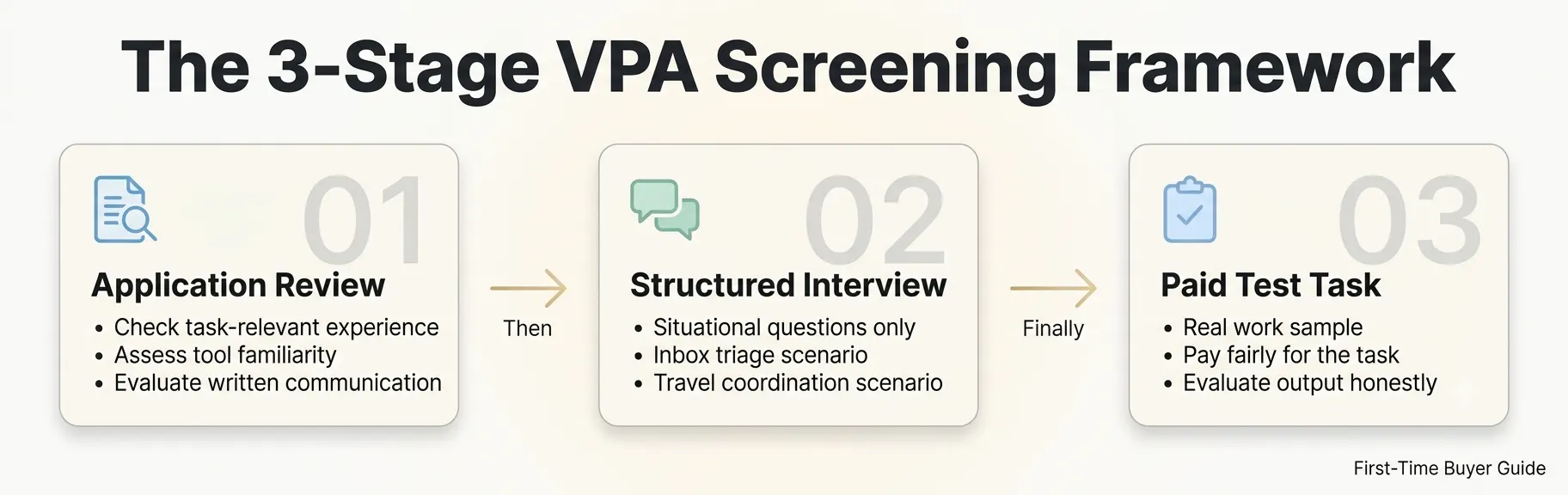
Stage 1: Application review
- Check for specific, task-relevant experience (not just years of “virtual assistant” work)
- Look for familiarity with your preferred tools
- Assess written communication quality – you will interact primarily in writing
Stage 2: Structured interview Ask situational questions, not generic ones:
- “Walk me through how you would triage an inbox with 150 unread emails.”
- “Describe a time you managed a last-minute travel change for an executive.”
- “What project management tools have you used, and how did you set them up for a new client?”
Stage 3: Paid test task This is non-negotiable. Assign a real, representative task from your actual workload:
- A short research brief
- A sample inbox triage exercise
- A scheduling scenario with competing priorities
Pay fairly for this task. Skipping it is the most common source of bad VPA hires – interviews do not reveal how someone actually works.
Step 5: Onboard with a Systems-First Approach
Hiring the right person solves only half the problem. A poor onboarding process undermines even excellent candidates.
The Onboarding Checklist for First-Time Buyers
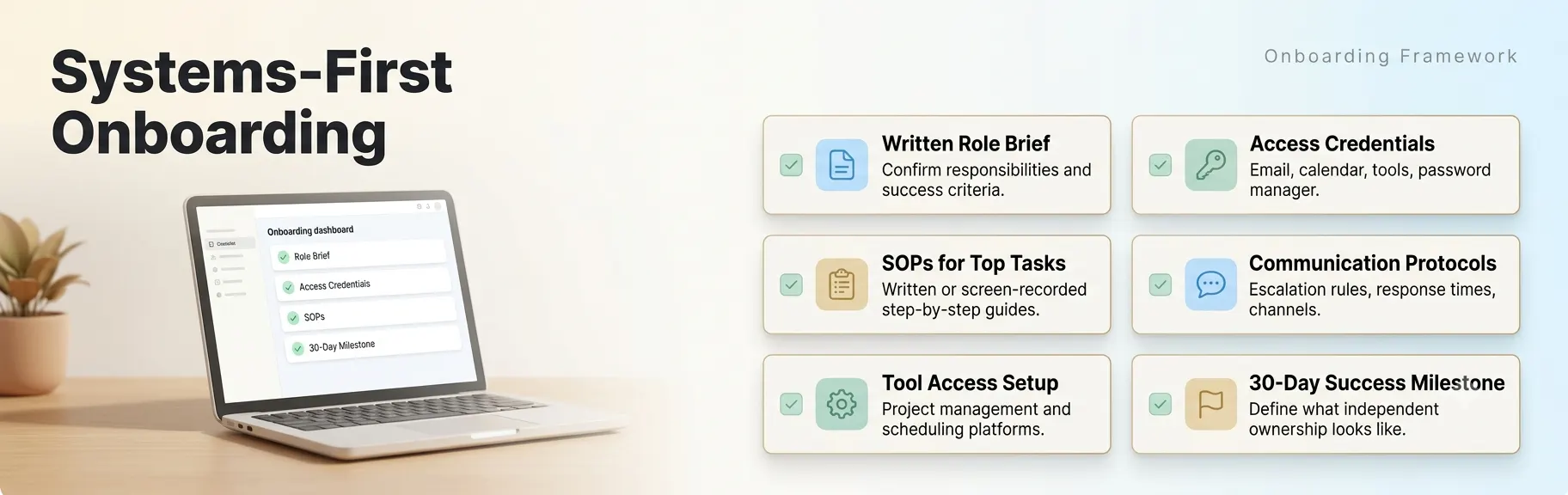
Before your VPA’s first day, prepare:
- A written role brief: Confirm responsibilities, priorities, and what “good work” looks like for each task
- Access credentials: Email delegation, calendar sharing, project management tools, password manager access
- Standard Operating Procedures (SOPs): Short written or video guides for your most frequent tasks
- Communication protocols: When to escalate, how quickly to respond, which channel to use for which type of update
- A 30-day success milestone: Define what you expect your VPA to own independently by the end of the first month
The onboarding investment pays back within two to three weeks when your VPA has clear systems to follow from day one.
6 Common Mistakes First-Time Buyers Make (and How to Avoid Them)
Even well-intentioned buyers make predictable mistakes when they hire a virtual personal assistant for the first time. Here are the most damaging ones – and how to sidestep them.
Mistake 1: Hiring Before Defining the Role
Bringing on a VPA before completing your task audit produces confusion on both sides. Your assistant spends their time guessing priorities while you wonder why the investment is not paying off.
Fix: Complete the task audit in Step 1 before you post a single job description.
Mistake 2: Prioritizing the Lowest Hourly Rate
A $4-per-hour VA who requires constant direction, produces inconsistent output, and leaves after six weeks costs far more than a $15-per-hour professional who operates independently from week two.
Fix: Calculate total cost including management overhead, rework time, and re-hiring risk – not just the headline rate.
Mistake 3: Skipping the Paid Test Task
Interviews test how well someone communicates. Paid test tasks test how well someone works. These are not the same thing.
Fix: Design a 1 to 2-hour test task that mirrors your actual workload. Pay for it. Evaluate the output honestly.
Mistake 4: Delegating Without Documentation
Telling a VPA what you want verbally in a one-time call and expecting perfect output is unrealistic. Without written SOPs, your assistant relies on memory, interpretation, and guesswork.
Fix: Create simple, step-by-step written or screen-recorded SOPs for your top five recurring tasks before the first working day.
Mistake 5: Over-Managing or Under-Managing
Some buyers hover constantly, reviewing every email before it is sent and second-guessing every decision. Others disappear entirely and wonder why quality drops. Both extremes damage the relationship.
Fix: Set clear decision boundaries. Define which tasks your VPA can complete autonomously, which require a quick approval check, and which always escalate to you.
Mistake 6: Treating the Relationship as Transactional
The highest-value VPA relationships develop over time. An assistant who understands your preferences, communication style, and strategic priorities delivers far more than one who is simply executing task tickets.
Fix: Invest in a structured weekly or bi-weekly check-in. Give feedback consistently. Treat the relationship as a professional partnership.
Expert Tips for Getting Maximum ROI from Your Virtual Personal Assistant
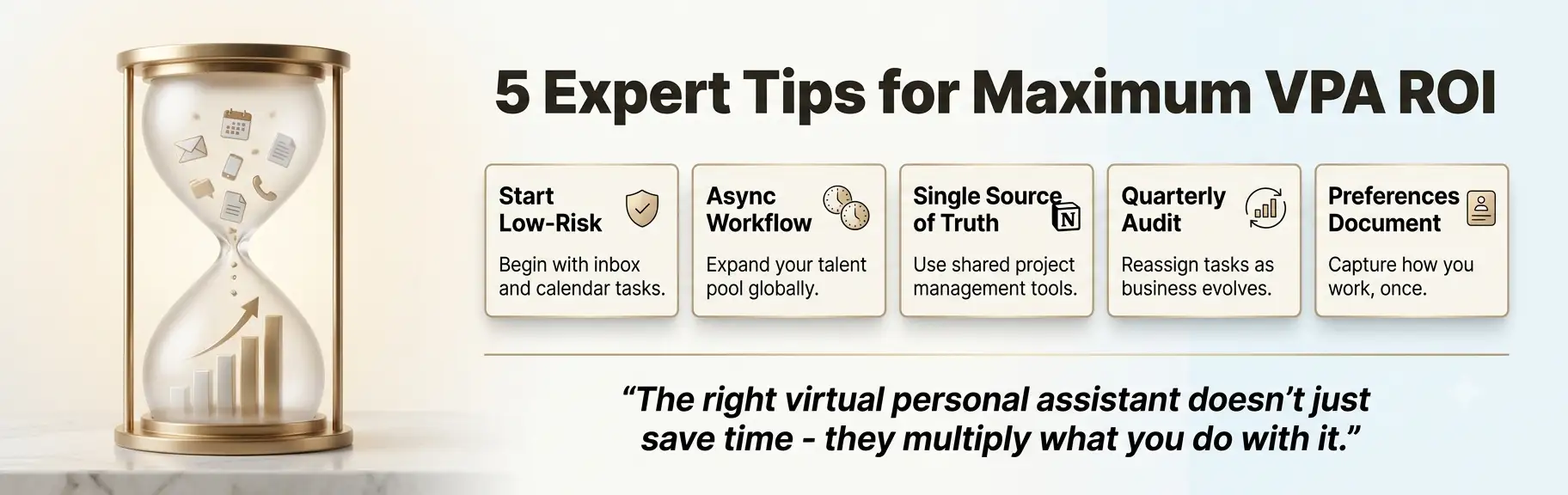
These are the practices that separate buyers who feel underwhelmed after six months from those who wonder how they managed without a VPA.
- Start with time-consuming, low-risk tasks. Begin with inbox management and scheduling before delegating anything sensitive. Build trust incrementally.
- Build an asynchronous workflow. Design your tasks and communication to work across time zones. This expands your talent pool and extends your effective working hours.
- Use a shared project management tool. Platforms like Asana, ClickUp, or Notion create a single source of truth for all tasks, priorities, and deadlines.
- Audit your delegation quarterly. As your business evolves, so should your VPA’s responsibilities. Schedule a quarterly review to reassign tasks, add new ones, and optimize the scope.
- Record your preferences in a “how I work” document. Capture communication preferences, formatting standards, recurring decisions, and personal logistics details. Your VPA uses this as a living reference.
Frequently Asked Questions About Hiring a Virtual Personal Assistant
What is the best way to hire a virtual personal assistant for the first time?
The most effective approach is to start with a detailed task audit to identify which responsibilities you want to delegate, then choose between a freelance platform and a managed VPA provider based on your budget and support needs. Write a specific job description, run a paid test task, and onboard with documented SOPs. According to Google’s guidance on helpful content, the most valuable information helps readers make informed decisions rather than just describing what a topic is.
How much does it cost to hire a virtual personal assistant in 2026?
Costs range widely depending on the model you choose. Freelance VPAs on open platforms typically charge between $8 and $35 per hour. Managed and dedicated VPA providers generally range from $1,200 to $3,000 per month for full-time support. Offshore VPAs in the Philippines and India typically cost $5 to $17 per hour. The right budget depends on the complexity of your tasks, required time zone overlap, and how much management overhead you are willing to take on.
What tasks can I delegate to a virtual personal assistant?
A virtual personal assistant can manage your inbox, calendar, travel bookings, research tasks, personal errands, CRM updates, document preparation, social media scheduling, appointment coordination, and event planning. The rule of thumb: if you can explain a task in a written SOP or short video, a trained VPA can execute it remotely.
Should I hire a freelance virtual PA or use a managed VPA service?
For project-based or irregular work, a freelance platform offers more flexibility at lower cost. For ongoing, high-trust daily support – where consistency, contextual memory, and reliability matter – a managed VPA service reduces risk and typically produces better long-term outcomes. The additional cost of a managed provider is often offset by saved hiring, training, and replacement time.
How long does it take to onboard a virtual personal assistant?
Most VPAs reach effective autonomy on core tasks within two to three weeks when onboarded with clear SOPs, tool access, and defined communication protocols. Without structured onboarding, the learning curve extends to six to eight weeks – and often results in early turnover.
What qualities should I look for when I hire a virtual personal assistant?
Look for strong written communication, demonstrated experience with your preferred tools (Gmail, Slack, Asana, Notion, or similar), a track record in roles with similar task complexity, and the ability to work proactively rather than waiting for direction. Reliability, time-zone alignment, and professional responsiveness matter more than raw skill level for most ongoing VPA roles.
Build a Smarter Workflow by Hiring the Right Virtual Personal Assistant
Hiring a virtual personal assistant is one of the highest-leverage decisions a busy professional or founder can make. When you approach it with the right framework – task audit first, hiring model second, structured screening third, and systems-first onboarding fourth – the return on investment compounds quickly.
The key principles to carry forward:
- Define before you delegate. A precise role brief attracts precise candidates.
- Test before you commit. A paid task reveals far more than any interview.
- Document before you onboard. SOPs and access protocols cut the learning curve in half.
- Invest in the relationship. The highest-value VPA partnerships develop through consistent feedback, clear boundaries, and mutual professional respect.
Whether you are reclaiming five hours per week or building a fully delegated personal operations layer, the right virtual personal assistant transforms how you spend your time – and ultimately, what you are able to build.
Ready to stop managing tasks and start focusing on outcomes? Explore VPERO’s dedicated virtual personal assistant solutions and connect with a pre-vetted VPA matched to your specific workflow needs.