
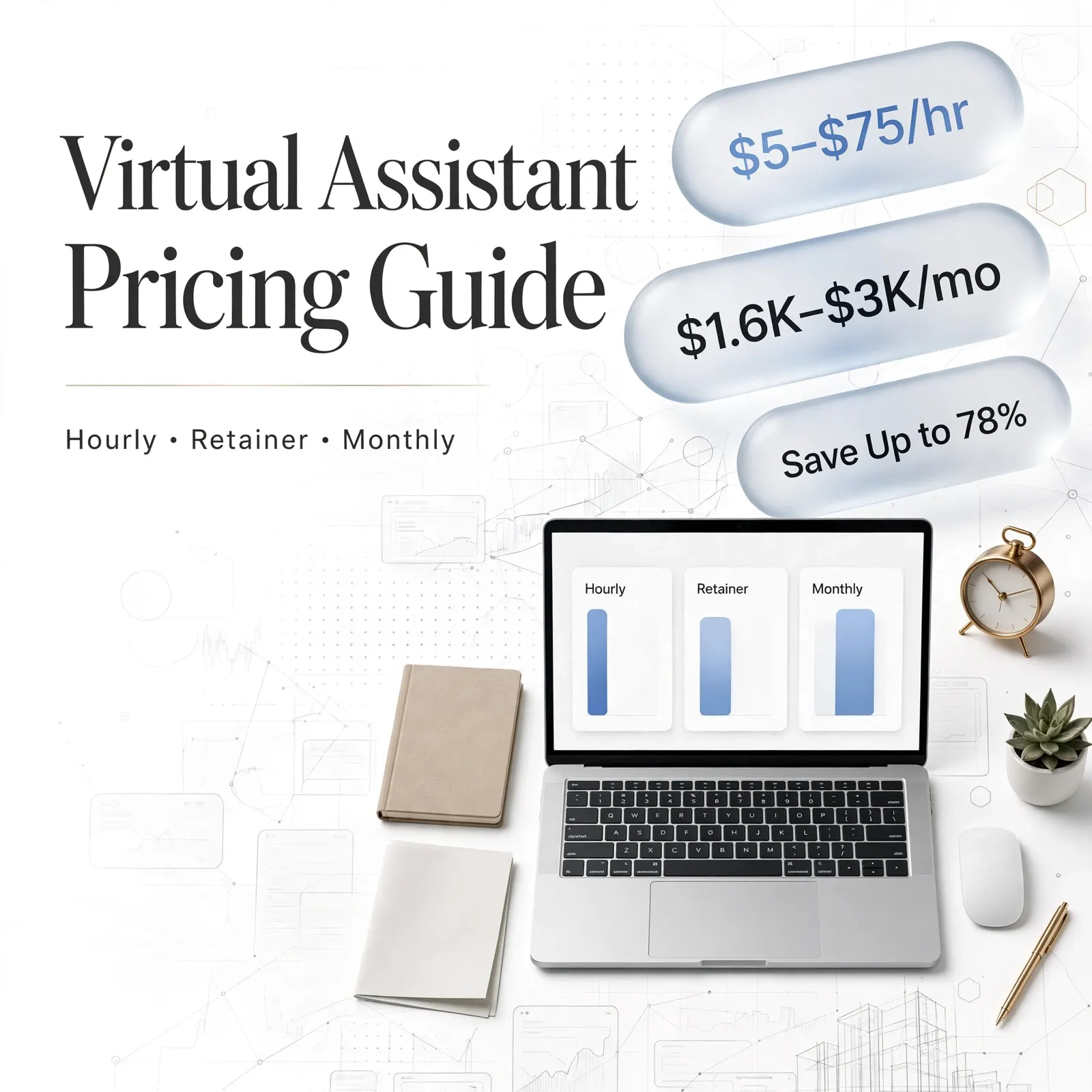
The cost of a virtual personal assistant ranges from $5 to $75 per hour in 2026, depending on geographic location, engagement model, experience tier, and task specialization – with full-time managed VPA services typically running $1,600 to $3,000 per month all-inclusive. Hourly billing suits variable or project-based workloads, while monthly retainer agreements offer 10 to 20 percent lower effective rates for clients with consistent, predictable delegation needs. Understanding the total cost of ownership – not just the headline rate – is the critical factor separating buyers who achieve strong ROI from those who overpay for underdelivered support.
If you are evaluating your options for the first time, the pricing landscape can feel confusing. Rates differ wildly across platforms, geographies, and engagement models. This guide breaks down every pricing structure with current benchmarks, so you can make a well-informed, budget-appropriate decision.
Before diving into the numbers, it is worth knowing that VPERO’s professional virtual personal assistant services provide dedicated, pre-vetted VPA support with transparent pricing – removing the guesswork from the engagement entirely.
Why Virtual Personal Assistant Pricing is Not a Single Number
Most buyers make one critical error early in their research: they look for a single, universal “virtual assistant rate.” That rate does not exist. According to current 2026 pricing benchmarks from TechBullion, the hourly cost of a virtual personal assistant spans from $3 to $75 – a 25x range within the same job title.
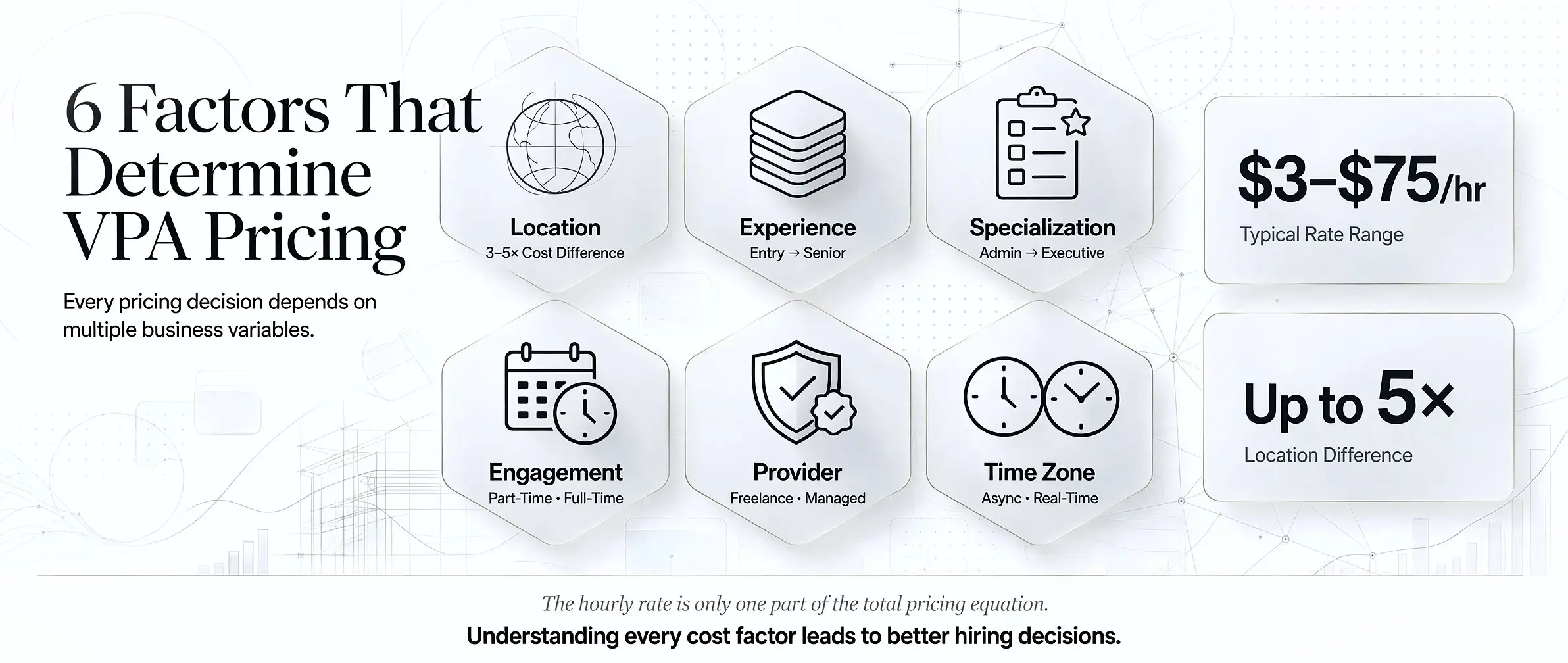
That spread exists because several independent variables all influence the final number simultaneously:
- Geographic location: A skilled VPA in the Philippines earns a fair local wage at $5 to $15 per hour; the same role costs $25 to $55 per hour in the United States simply due to cost-of-living differences.
- Engagement model: Hourly freelance, monthly retainer, managed agency, and dedicated platform pricing each carry different structures, trade-offs, and effective rates.
- Experience and specialization: A general admin VPA commands a lower rate than one with CRM expertise, executive-level communication skills, or specialist vertical knowledge.
- Part-time vs. full-time: Fractional or shared VPAs cost less per month but deliver less output and context continuity than a dedicated full-time hire.
- Platform or direct hire: Marketplace platforms add overhead in the form of service fees; managed providers bundle vetting, HR, and replacement support into a premium rate.
Understanding which of these variables applies to your situation is the foundation of a smart pricing decision.
The Core Pricing Models: How Virtual Personal Assistants Charge
There are three primary billing structures you will encounter when evaluating virtual personal assistant costs. Each suits a different type of buyer and workload.
1. Hourly Rate Pricing
Hourly billing is the most widely used model on freelance platforms. You pay for actual hours worked, and the rate varies based on the VPA’s location, skill level, and platform.
Current 2026 hourly rate benchmarks:
| VPA Location | Entry-Level | Mid-Level | Senior/Specialist |
|---|---|---|---|
| Philippines | $5 – $9/hr | $10 – $17/hr | $18 – $25/hr |
| India | $4 – $8/hr | $9 – $15/hr | $16 – $22/hr |
| Latin America | $10 – $15/hr | $16 – $25/hr | $26 – $35/hr |
| South Africa | $8 – $14/hr | $15 – $22/hr | $23 – $32/hr |
| United States | $20 – $30/hr | $30 – $50/hr | $50 – $75/hr |
| United Kingdom | $18 – $28/hr | $28 – $45/hr | $45 – $70/hr |
When hourly pricing works best:
- Your workload is irregular or seasonal
- You are testing a new VPA before committing to a longer engagement
- You have one-off projects rather than ongoing daily support needs
- You need flexibility to scale hours up or down month to month
The key risk with hourly pricing: Without clear scope and time-tracking oversight, hourly billing can become difficult to predict and budget for. It also creates a weak incentive structure: slower completion takes longer and therefore costs more.
2. Monthly Retainer Pricing
A monthly retainer is a fixed fee for a pre-agreed number of hours per month. This model is widely used for ongoing VPA relationships and offers both the buyer and the VPA more predictability.
How retainer pricing compares to hourly:
Retainer rates run approximately 10 to 20 percent lower per hour than equivalent pay-as-you-go rates, because the VPA values the guaranteed income and the buyer benefits from simplified billing and consistent availability.
Typical monthly retainer price points for 2026:
| Hours per Month | Offshore VPA (Philippines/India) | Nearshore VPA (LatAm/SA) | US-Based VPA |
|---|---|---|---|
| 10 hours/month | $70 – $130 | $130 – $220 | $250 – $450 |
| 20 hours/month | $130 – $260 | $260 – $430 | $480 – $860 |
| 40 hours/month | $240 – $500 | $500 – $860 | $900 – $1,700 |
| 80 hours/month | $450 – $960 | $960 – $1,700 | $1,750 – $3,200 |
| 160 hours/month (full-time) | $833 – $1,920 | $1,920 – $3,400 | $3,500 – $6,400 |
When retainer pricing works best:
- You have consistent, predictable weekly tasks to delegate
- You want to build a long-term, context-rich relationship with your VPA
- You prefer simplified monthly billing over tracking hourly usage
- You value guaranteed availability at a pre-agreed capacity
Important retainer caveat: Unused hours in a retainer period typically do not roll over. If your workload drops below the contracted hours in a given month, you still pay the full retainer amount – effectively increasing your true hourly cost. Always size your retainer accurately against your actual monthly task volume.
3. Monthly Package and Managed Service Pricing
Managed VPA providers bundle vetting, onboarding, HR, payroll, and replacement support into an all-inclusive monthly package. This model commands a premium over direct freelance hiring, but it removes significant operational overhead from the buyer.
Managed VPA service pricing benchmarks (2026):
| Package Type | Monthly Cost Range | What Is Included |
|---|---|---|
| Part-time package (20 hrs/week) | $800 – $1,400/month | Vetted VPA, account manager, replacements |
| Full-time dedicated (40 hrs/week) | $1,600 – $3,000/month | All of above plus priority matching |
| Executive VPA package | $2,500 – $4,500/month | Senior-level VPA, extended scope, priority support |
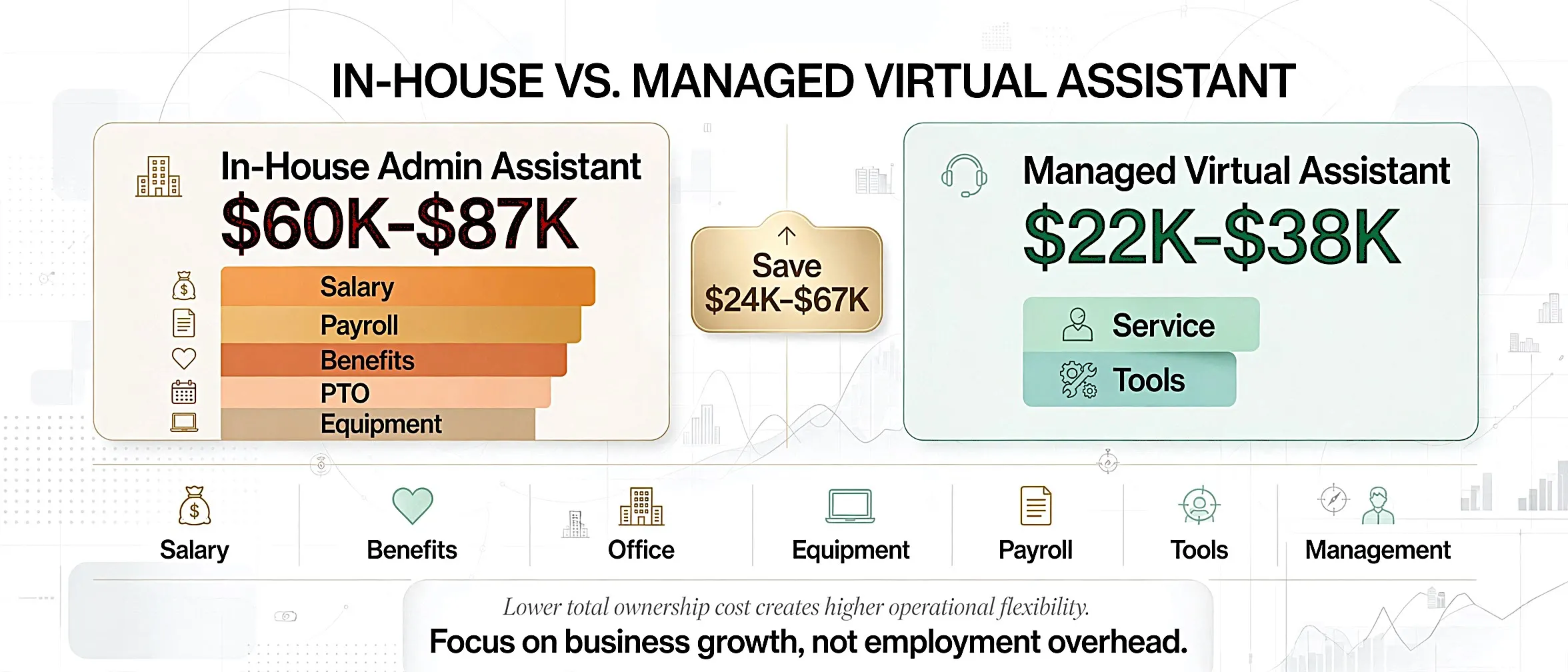
For context: a full-time managed VPA costs $20,900 to $40,000 per year, compared to $64,000 to $96,000 for an equivalent in-house hire in the United States – a direct labor saving of $24,000 to $56,000 annually before factoring in benefits, payroll taxes, office space, and equipment.
What Drives the Cost of a Virtual Personal Assistant: 6 Key Factors
Rather than focusing purely on the headline rate, buyers should evaluate virtual personal assistant pricing across the following dimensions:
Factor 1: Geographic Location
Location remains the single largest pricing variable. Offshore talent markets – particularly the Philippines, India, and parts of Latin America – produce large pools of English-proficient, college-educated professionals at rates 3 to 5 times lower than equivalent US-based hires. For administrative and personal assistance tasks that do not require physical presence, location is an efficiency lever, not a quality compromise.
Factor 2: Experience Tier
Entry-level VPAs with one to two years of experience handle routine tasks well: email management, calendar scheduling, data entry, and basic research. Mid-level VPAs with three to five years of experience manage more complex workflows: CRM management, project coordination, and executive communication. Senior VPAs with deep specialization – legal, healthcare, financial services, or executive-level support – command rates at the top of the range.
Factor 3: Task Specialization
Generalist administrative support sits at the lower end of the pricing range. As task complexity increases – toward bookkeeping, marketing execution, sales support, or technical coordination – rates climb accordingly. Matching the correct experience tier to your actual task requirements avoids overpaying for capabilities you do not need.
Factor 4: Part-Time vs. Full-Time Engagement
Part-time VPAs cost less per month but typically operate as shared resources: they may support multiple clients simultaneously. Full-time dedicated VPAs deliver significantly higher context continuity, faster response times, and deeper workflow ownership. For high-volume or relationship-sensitive delegation, the full-time premium pays back quickly in output quality and reduced oversight.
Factor 5: Freelance Platform vs. Managed Provider
Freelance platforms like Upwork transfer vetting, management, and replacement risk entirely to the buyer. Managed providers absorb that operational burden in exchange for a higher rate. The right choice depends on how much time and management capacity you have available. Buyers who lack the bandwidth to screen candidates, run test tasks, and re-hire when needed typically find managed providers more cost-effective over a 12-month horizon.
Factor 6: Time Zone Alignment
Near-real-time responsiveness – for tasks like calendar management, travel coordination, or urgent inbox triage – requires time zone overlap. VPAs with strong alignment to your working hours may command a slight premium over asynchronous offshore arrangements, but the productivity difference for time-sensitive roles is typically worth it.
The True Cost of a Virtual Personal Assistant: Total Cost of Ownership
The headline hourly or monthly rate tells only part of the pricing story. Buyers who calculate only the labor cost routinely underestimate the full investment. To accurately assess virtual personal assistant pricing, add these often-overlooked cost components:
Hidden Cost Categories
- Onboarding time: Expect 10 to 20 hours of management time in the first month to brief your VPA, create SOPs, and establish workflows. At an executive’s effective hourly rate, this is a real cost.
- Software and tool access: Project management tools, password managers, communication platforms, and scheduling software add $50 to $200 per month in tool overhead for most setups.
- Management overhead: Even a highly capable VPA requires a regular check-in, performance feedback, and periodic process updates. Budget one to two hours per week of your time for this.
- Quality rework: For tasks that require multiple iterations before they meet your standard, factor in the time cost of review and revision cycles, particularly in the first 30 to 60 days.
- Re-hiring risk: On freelance platforms, when a VPA leaves or underperforms, you absorb the full cost of re-screening, re-testing, and re-onboarding a replacement. Managed providers cover this within their service fee.
Practical rule of thumb: Add 20 to 25 percent above your baseline VPA labor cost when calculating total monthly spend. This buffer accounts for tools, management time, and contingencies without creating budget surprises.
Cost of a Virtual Personal Assistant vs. In-House Hire: A Direct Comparison
For buyers evaluating whether to hire a VPA or expand their in-house team, the financial case for a virtual personal assistant is straightforward.
Full Cost Comparison Table: VPA vs. In-House Admin Assistant (US, 2026)
| Cost Component | In-House Admin Assistant | Full-Time Managed VPA (Offshore) |
|---|---|---|
| Base salary | $42,000 – $55,000/yr | Included in package |
| Employer payroll taxes (~8%) | $3,360 – $4,400/yr | Not applicable |
| Health insurance contribution | $6,000 – $8,000/yr | Not applicable |
| Paid time off (15 days avg.) | $2,400 – $3,200/yr | Not applicable |
| Equipment and software | $1,500 – $3,000/yr | Largely self-supplied |
| Office space allocation | $3,000 – $8,000/yr | Not applicable |
| Recruitment and onboarding | $2,000 – $5,000 (one-time) | Covered by provider |
| Total annual cost | $60,260 – $86,600/yr | $19,200 – $36,000/yr |
| Annual saving with VPA | – | $24,000 – $67,000/yr |
The savings are substantial at every tier. Even a mid-range dedicated VPA arrangement at $2,500 per month ($30,000 per year) delivers a saving of $30,000 to $57,000 annually compared to a fully loaded in-house equivalent. According to McKinsey research on workforce productivity, the financial case for remote delegation has only strengthened as operational tooling has improved.
Pricing by Task Type: What Different VPA Roles Cost
Not all virtual personal assistant work is priced the same. Understanding the cost differential by task category helps buyers allocate budget more accurately.
VPA Task Category Pricing Reference
| Task Category | Offshore Rate | Nearshore Rate | US-Based Rate |
|---|---|---|---|
| General admin (inbox, calendar, data entry) | $5 – $12/hr | $12 – $22/hr | $22 – $35/hr |
| Travel planning and logistics coordination | $8 – $14/hr | $14 – $25/hr | $25 – $40/hr |
| Research and briefing documents | $8 – $15/hr | $15 – $28/hr | $28 – $45/hr |
| Social media scheduling and monitoring | $7 – $13/hr | $13 – $22/hr | $22 – $38/hr |
| CRM management and data updates | $10 – $18/hr | $18 – $30/hr | $30 – $50/hr |
| Executive-level personal assistance | $15 – $25/hr | $25 – $40/hr | $40 – $75/hr |
Buyers with mixed workloads – combining general admin with occasional specialist tasks – often find that a mid-range dedicated VPA at a flat monthly rate is more cost-effective than trying to separate tasks across multiple hourly freelancers.
5 Costly Pricing Mistakes to Avoid When Budgeting for a Virtual Personal Assistant
Mistake 1: Choosing the Lowest Rate Without Calculating ROI
A $4-per-hour VPA who requires constant direction, produces inconsistent output, and needs frequent replacement often costs more over 12 months than a $15-per-hour professional who delivers reliable, autonomous work from week three onward.
Fix: Calculate your expected monthly output value – not just your labor cost. If your VPA frees 15 hours of your time per week at your effective hourly opportunity cost, the ROI calculation changes dramatically.
Mistake 2: Oversizing a Retainer for Your Actual Workload
Purchasing a 160-hour monthly retainer when your actual workload only sustains 90 hours of productive VPA time inflates your effective rate significantly.
Fix: Conduct a task audit before committing to a retainer. Start at a lower hour tier, measure actual utilization in month one, and scale up from there.
Mistake 3: Ignoring Platform Fees
Freelance marketplaces charge service fees of 5 to 20 percent on top of the quoted hourly rate – sometimes distributed across client and freelancer, sometimes absorbed entirely by the client depending on the platform’s billing model.
Fix: Calculate the all-in rate including platform fees, not just the VPA’s listed hourly rate. On some platforms, the total cost is 15 to 20 percent higher than the rate displayed on a profile.
Mistake 4: Underestimating Onboarding Investment
First-time buyers routinely assume a new VPA hits full productivity in week one. In practice, building the SOPs, granting tool access, calibrating communication styles, and establishing workflow patterns takes three to four weeks of active investment.
Fix: Treat the first month as a partial ROI month. Budget for it explicitly rather than measuring the full-speed rate from day one.
Mistake 5: Conflating Cheap with Good Value
Price reflects supply and demand for a skill at a given market. Entry-level rates are not inherently inferior, but they are appropriate for well-defined, low-complexity tasks. Applying an entry-level rate to executive-level personal assistance consistently underdelivers.
Fix: Match the price tier to the actual task complexity. Over-hiring for routine tasks wastes budget; under-hiring for complex tasks wastes time.
Expert Tips for Getting the Best Value from Your VPA Investment
These principles separate buyers who maximize ROI from those who find the arrangement disappointing:
- Start with a paid trial task. Before committing to a retainer, assign a representative task and pay a fair hourly rate for it. The output quality predicts long-term performance far more accurately than any interview.
- Build SOPs before you hire. Documented processes reduce onboarding time by 40 to 60 percent and allow your VPA to reach productive autonomy much faster.
- Right-size your hour tier to actual need. Review your VPA’s utilization in month one and adjust. Most buyers either over-purchase hours in month one or under-purchase and create bottlenecks.
- Invest in tool overlap. Shared project management tools, calendar integrations, and a password manager cost under $100 per month and eliminate the largest source of friction and miscommunication in remote VPA relationships.
- Track output value, not just hours. The ROI of a virtual personal assistant is ultimately measured in time reclaimed and outcomes delivered – not in hours billed. Define output KPIs alongside your budget to keep the engagement results-focused.
How to Choose the Right Pricing Model for Your Situation
Use this decision framework to identify the most appropriate pricing structure for your needs:
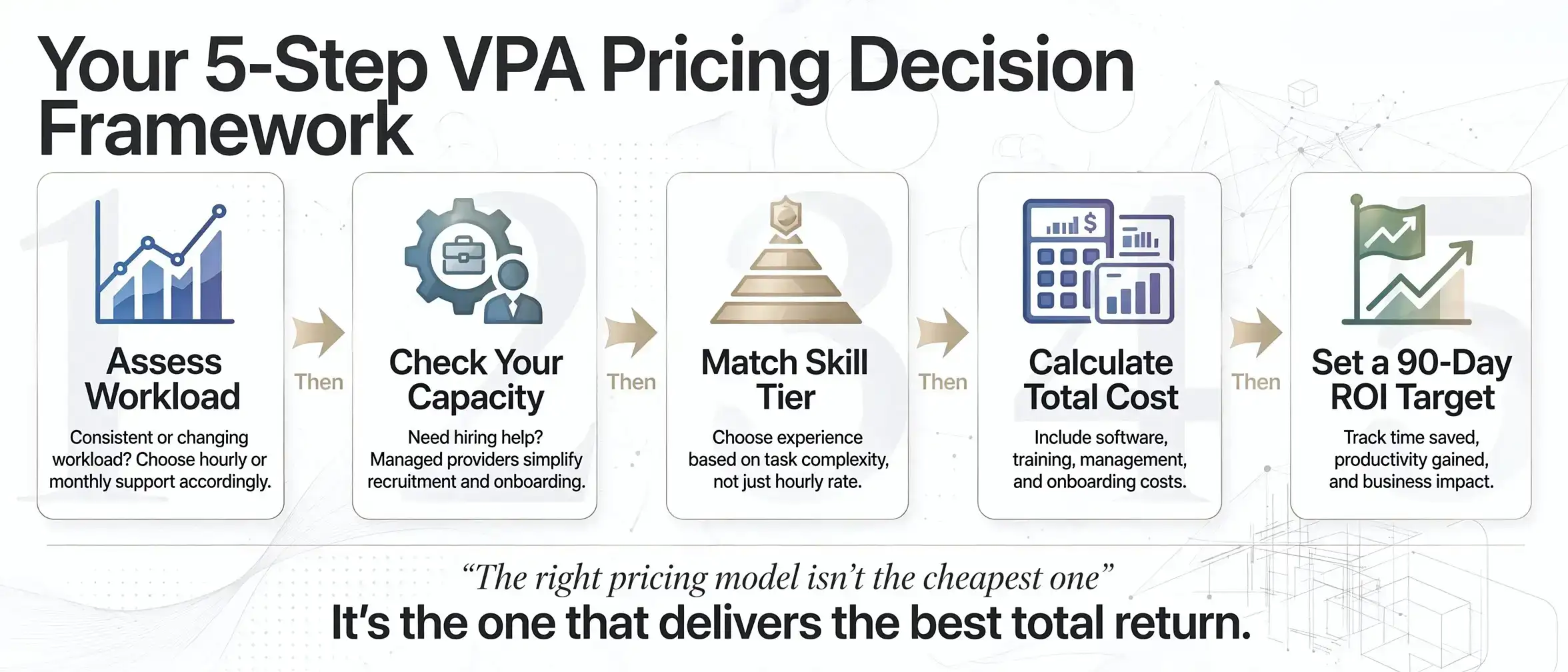
- Assess your workload consistency. If your task load is steady week-to-week, a retainer or managed monthly package is more cost-efficient. If it fluctuates significantly, hourly or pay-as-you-go offers more flexibility.
- Calculate your management capacity. If you have time to screen, onboard, and manage a freelance VPA, the lower hourly rates of freelance platforms are accessible. If you need a provider to handle that operational layer, managed pricing is worth the premium.
- Define your task complexity level. Match your required VPA skill tier to your task list honestly. Overpaying for senior-level expertise on routine admin work wastes budget; underpaying for complex executive support creates quality problems.
- Factor in total cost of ownership. Add tool costs, onboarding time, and management overhead to your baseline labor cost before comparing options.
- Set a 90-day ROI target. Define what success looks like in concrete, measurable terms: hours reclaimed per week, specific tasks removed from your plate, response time improvements. Use this target to evaluate pricing models against expected output – not just against each other.
Frequently Asked Questions About Virtual Personal Assistant Costs
What is the average cost of a virtual personal assistant in 2026?
The average cost of a virtual personal assistant in 2026 ranges from $5 to $75 per hour, depending on location, experience, and task specialization. Offshore VPAs from the Philippines or India typically charge $5 to $17 per hour. US-based VPAs range from $25 to $75 per hour. Full-time managed VPA services from dedicated providers average $1,600 to $3,000 per month all-inclusive, covering vetting, HR, and support infrastructure.
Is hourly or monthly pricing better for a virtual personal assistant?
Monthly retainer pricing is typically more cost-efficient for buyers with consistent, predictable weekly task loads. Retainer rates run 10 to 20 percent lower per effective hour than equivalent pay-as-you-go billing. Hourly pricing suits variable or project-based workloads where flexibility outweighs the cost savings of a committed engagement.
What hidden costs should I expect when budgeting for a virtual personal assistant?
Beyond the headline labor rate, budget for tool and software costs ($50 to $200 per month), management and onboarding time in the first 30 to 60 days, and potential re-hiring costs on freelance platforms if the initial match does not work out. A practical rule is to add 20 to 25 percent above your baseline VPA rate to cover total cost of ownership.
How much can I save by hiring a virtual personal assistant instead of a full-time employee?
A fully loaded in-house admin assistant in the United States typically costs $60,000 to $87,000 per year when salary, benefits, payroll taxes, office space, and equipment are included. A full-time offshore managed VPA typically costs $19,200 to $36,000 per year. The annual saving ranges from $24,000 to $67,000 depending on the VPA tier and specific overhead components.
Does the cost of a virtual personal assistant vary by the type of tasks assigned?
Yes, task complexity is a meaningful pricing factor. General administrative tasks – inbox management, calendar scheduling, and data entry – sit at the lower end of the rate range. Higher-complexity work, such as executive personal assistance, CRM management, travel coordination, and research briefings, commands proportionally higher rates. Matching the correct skill tier to your actual task requirements is one of the most effective ways to control your virtual personal assistant budget.
Are managed VPA providers worth the premium over freelance platforms?
For buyers who need consistent, ongoing daily support and lack the time to screen, onboard, and replace candidates independently, managed VPA providers typically deliver stronger long-term value despite the higher monthly cost. The premium covers vetting, replacement risk, HR administration, and ongoing quality oversight – costs that freelance buyers absorb themselves, often invisibly, in management time and re-hiring cycles.
Budgeting Smartly for the Right Level of VPA Support
The cost of a virtual personal assistant is not a fixed number – it is a range shaped by your location preferences, required skill level, engagement model, and operational needs. What matters more than finding the cheapest rate is finding the most cost-effective structure for your actual workload.
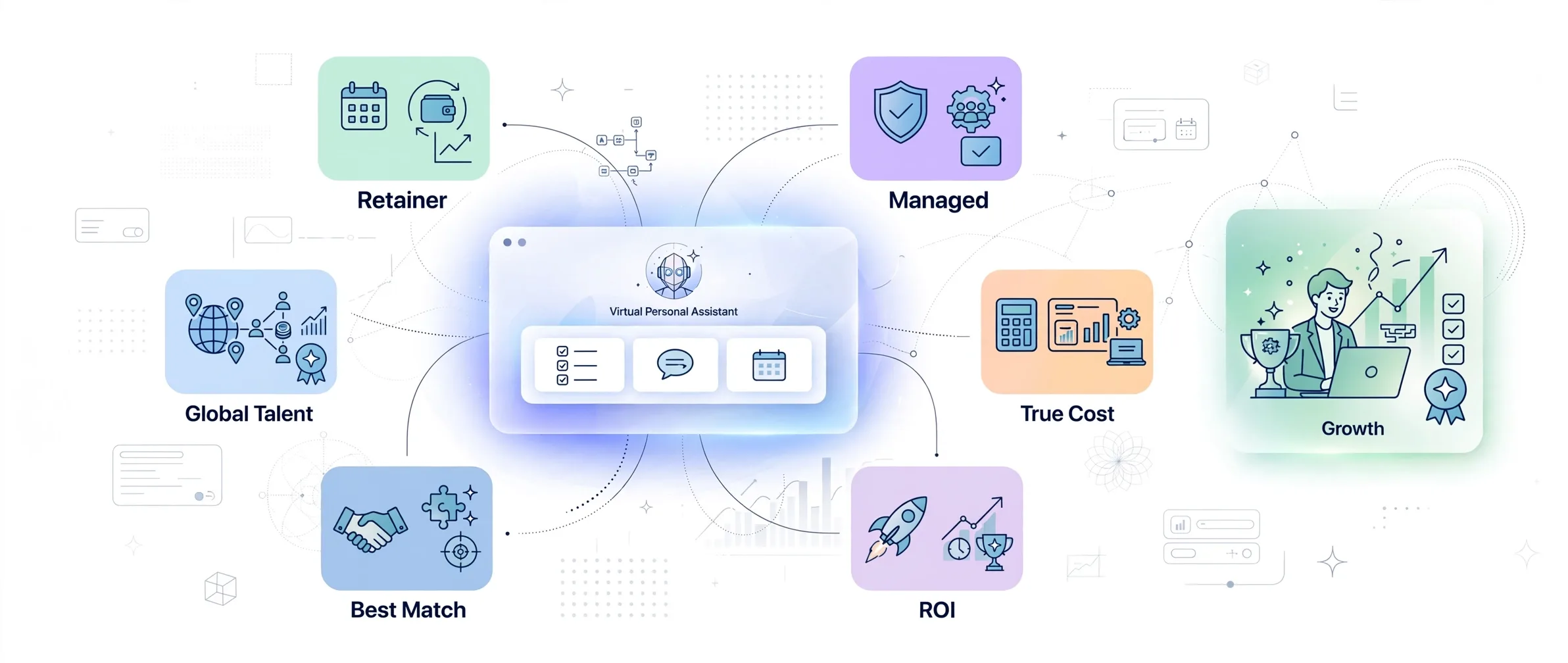
To recap the key pricing principles:
- Offshore VPAs offer the strongest cost-to-quality ratio for most administrative and personal assistance tasks, typically running $5 to $17 per hour.
- Monthly retainer agreements reduce effective hourly rates by 10 to 20 percent and suit consistent, predictable workloads.
- Managed VPA providers bundle all operational overhead into a transparent monthly fee, making them more cost-effective over a 12-month horizon for buyers without time to manage the process themselves.
- Total cost of ownership – including tools, onboarding time, and management overhead – runs 20 to 25 percent above the baseline labor cost for most engagements.
- ROI is the right metric: a VPA who reclaims 15 hours of your week consistently delivers far more value than a low hourly rate on a poorly matched engagement.
Whether you are budgeting for a part-time personal admin or a full-time dedicated executive assistant, the investment pays back faster when the scope is well-defined and the engagement is professionally managed.
Ready to move from pricing research to tangible productivity gains? and find a pre-matched, professionally supported VPA solution built around your specific needs and budget.
Connect with Dedicated Virtual Personal Assistant Specialists →